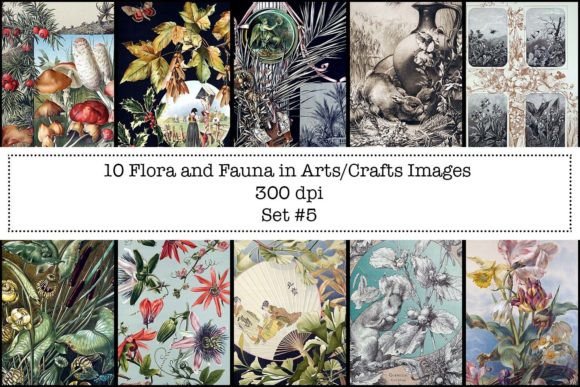
Flora Fauna in Art Craft – Set 1: Timeless Botanical Motifs for Modern Makers
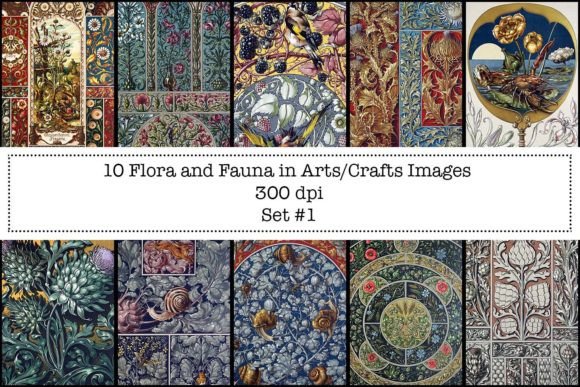
Imagine opening a weathered, cloth-bound volume from 1886—its spine cracked, pages softly yellowed—and finding inside not just botanical illustrations, but living design language. That’s the quiet magic of Flora Fauna in Art Craft – Set 1. These ten high-resolution JPEGs are carefully sourced from Anton Seder’s seminal work, Die Pflanze in Kunst und Gewerbe (The Plant in Arts and Crafts), a foundational text that bridged scientific observation with decorative artistry during the height of the Arts and Crafts movement.
What Makes These Patterns So Distinctive?
Unlike mass-produced clipart or AI-generated florals, each image in Flora Fauna in Art Craft – Set 1 carries the hand-guided precision and organic restraint of late-19th-century engraving and lithography. Seder didn’t aim for photographic realism—he sought structural clarity, rhythmic repetition, and symbolic harmony. You’ll notice how stems curl with measured grace, leaves unfurl in balanced asymmetry, and blossoms cluster with intentional spacing—not randomness, but rhythm.
The files themselves reflect thoughtful stewardship: scanned at 300 dpi for crisp physical output, preserved in faithful grayscale or soft-toned originals (depending on the source plate), and minimally restored. Where the original page showed wear—faint creases, marginal foxing, or minor ink loss—light spot healing has been applied. No digital overpainting. No stylistic reinterpretation. What you get is authenticity, intact.
Why Artists & Crafters Reach for This Set Again and Again
It’s not just nostalgia that keeps Flora Fauna in Art Craft – Set 1 in constant rotation across studios and creative businesses. It’s utility—deep, flexible, and surprisingly contemporary.
- Print-ready versatility: At 300 dpi, every image holds sharp detail even when enlarged to 8×10” or scaled down for delicate journal corners. Try printing on kraft paper for earthy junk journal spreads—or on vellum for layered collages that glow with subtle translucence.
- Digital adaptability: Drop any pattern into Procreate, Photoshop, or Canva. Adjust contrast to deepen line weight, invert tones for bold silhouettes, or overlay textures (like watercolor washes or linen scans) without losing integrity. Because they’re clean-line JPEGs—not vector files—they behave predictably across platforms, with no font or embedding complications.
- Commercial safety: You’re cleared to use these in physical products (stitched notebooks, pressed-floral greeting cards, embroidered patches) and digital offerings (printable planners, Canva templates, SVG-cut files for crafters). Just remember: resale as-is—uploading the raw JPEGs to a stock site or bundling them unchanged—is not permitted. The value lies in your interpretation, not redistribution.
Real-World Uses You Might Not Expect
Most people first reach for Flora Fauna in Art Craft – Set 1 for scrapbooking or altered book work—and yes, those applications shine. But dig deeper, and you’ll find quieter, more strategic roles:
- Brand texture layering: A small, repeated vine motif from Pattern #4 makes an elegant watermark behind product photography or a subtle border on email headers—evoking heritage without shouting “vintage.”
- Stencil foundation: Print Pattern #7 onto transparency film, tape it to wood or clay, and trace with a stylus. Then carve, etch, or emboss. The clean linework translates flawlessly to tactile surfaces.
- Pattern-matching practice: For textile designers learning repeat construction, these motifs offer ideal starting points. Rotate, mirror, or offset a single stem element to build seamless tiles—no guesswork needed on proportion or negative space.
- Educational illustration: Homeschoolers and Waldorf educators use Pattern #2 (a detailed fern study) alongside botany lessons—not as decoration, but as accurate, calm visual reference that invites slow looking and careful sketching.
How to Choose the Right Pattern for Your Project
Not all ten images serve the same purpose—even within one aesthetic family. Here’s how to match intention with motif:
- Need movement and flow? Go for Pattern #1 (a sinuous climbing vine) or #9 (a cascading wisteria branch). Their directional energy guides the eye naturally—ideal for borders, page dividers, or scroll-style digital backdrops.
- Prefer structure and geometry? Patterns #5 and #8 feature symmetrical leaf arrangements and radial blossoms. They anchor layouts, balance typography, and lend formality to invitation suites or branding elements.
- Working with limited space? Pattern #3—a compact, upright sprig of lily-of-the-valley—fits neatly into margins, corner embellishments, or tiny die-cut tags. Its scale invites intimacy, not grandeur.
- Seeking contrast or focal point? Pattern #6 stands out for its bold, simplified dahlia silhouette. Use it alone—centered on a cover, stamped in metallic foil, or isolated as a logo mark—to create instant visual weight.
A Note on Authenticity and Ethical Use
These aren’t “vintage-style” designs. They’re genuine artifacts—published decades before Art Nouveau fully bloomed, yet already humming with its core values: reverence for nature, respect for craftsmanship, and belief in ornament as meaningful, not merely decorative. That lineage matters.
When you incorporate Flora Fauna in Art Craft – Set 1 into your work, you’re not just borrowing visuals—you’re tapping into a philosophy. One that saw the vein of a leaf as architecture, and the curve of a petal as rhythm. That’s why so many makers report feeling more grounded, more deliberate, after working with these patterns. There’s a slowness encoded in their lines—a counterpoint to today’s speed-driven design culture.
That said, authenticity comes with responsibility. The license permits commercial use—but only when transformed. Printing Pattern #10 onto tea towels? Yes. Turning it into a repeating fabric print for an Etsy shop? Also yes. Selling the file itself on a marketplace? No. The distinction isn’t legal nitpicking—it’s about honoring the labor behind both Seder’s original vision and the care taken to preserve it for modern hands.
Getting Started Without Overthinking
If you’re new to using vintage botanical art in your process, start small. Download Flora Fauna in Art Craft – Set 1, open one JPEG in your preferred app, and try just one thing:
- Invert the colors and place it over a photo background.
- Print it at 50% size, cut it out, and glue it beside handwritten journal notes.
- Use it as a mask in Photoshop to reveal texture beneath a solid color layer.
- Trace it by hand onto tracing paper—then redraw it freehand, letting your own line quality emerge.
You don’t need a plan. You don’t need perfection. You just need curiosity—and ten quietly confident patterns waiting to meet your next idea.
Final Thought: Why These Images Still Feel Fresh
Design trends fade. Filters cycle. But clarity endures. Balance endures. The quiet intelligence of a well-observed plant form—rendered with patience and purpose—doesn’t expire. That’s why Flora Fauna in Art Craft – Set 1 feels equally at home in a Berlin-based letterpress studio, a Tokyo-based digital planner brand, and a rural Oregon mixed-media workshop. It doesn’t shout. It settles in. And once it does, it tends to stay.