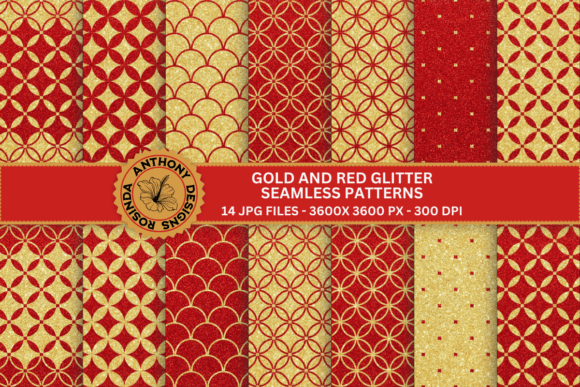
Gold Red Glitter Seamless Patterns: A Practical Guide for Designers and Crafters
Gold Red Glitter refers to a curated collection of seamless digital patterns that combine warm metallic gold tones with rich, saturated reds—often enhanced with subtle glitter textures or shimmer effects. Unlike flat solid-color backgrounds or generic holiday motifs, Gold Red Glitter patterns are designed with intentional visual rhythm, balanced contrast, and repeat logic that supports real-world application across both digital and physical media. What sets them apart is not just the color pairing—though gold and red carry strong cultural resonance—but how the glitter element is integrated: not as overwhelming sparkle, but as a refined, tactile suggestion that holds up at scale and in print.
How Gold Red Glitter Fits Into Broader Design Contexts
When evaluating pattern resources, designers often weigh options like vector-based repeats, hand-drawn illustrations, photographic textures, or AI-generated motifs. Gold Red Glitter sits firmly in the high-resolution raster pattern category—specifically optimized for versatility rather than maximal artistic uniqueness. That makes it distinct from illustrative pattern packs (which prioritize narrative or stylistic flair) and from minimalist geometric repeats (which emphasize structure over warmth or occasion-specific tone).
Compared to free or low-cost alternatives, Gold Red Glitter offers consistency in resolution (300 DPI), dimension (3600 × 3600 px), and seamless tiling behavior—meaning no visible seams when repeated across large surfaces. Free patterns may lack this reliability: some tile poorly, others appear pixelated when scaled, and many don’t hold contrast well on fabric or printed stationery. In contrast, Gold Red Glitter’s uniform sizing and resolution support predictable outcomes whether you’re printing wedding napkins or building a Shopify product background.
Strengths Across Real-World Use Cases
The 14 included patterns cover variations in density, glitter intensity, and layout—some feature tight, all-over micro-glitter; others use larger gold foil shapes against a deep red ground. This range supports different functional needs:
- Scrapbooking & cardmaking: Patterns with lower glitter density work well behind photos or layered under die-cut elements without competing visually.
- Web and UI backgrounds: Lighter variants provide subtle texture without slowing load times—especially since JPG format keeps file sizes manageable.
- Print-on-demand (POD) products: The 12″ × 12″ size maps cleanly to common fabric swatch dimensions and works with most POD platform upload requirements.
- Nail art & small-scale crafts: High resolution allows clean scaling down to thumbnail-sized motifs for stencils or decals.
- Wall art & banners: Seamless tiling means you can extend any pattern across wide-format prints without manual editing or visible breaks.
This adaptability stems from deliberate design constraints—not arbitrary aesthetics. Each pattern avoids overly directional lines or asymmetrical focal points, which would disrupt tiling. Instead, they rely on radial symmetry, balanced scatter, or rhythmic repetition—principles that serve function first.
Tradeoffs and Situational Limitations
While Gold Red Glitter excels in consistency and ease of use, it isn’t universally optimal. Its strength lies in cohesion—not customization. If your project requires editable layers (e.g., adjusting glitter opacity independently of base color), vector formats like SVG or AI would be more suitable—even if they demand more technical familiarity.
Likewise, the fixed JPG format means no built-in transparency. For designs needing overlays (e.g., placing text directly over a pattern without a white box), you’ll need to add masking or blending modes in your editor. PNG versions would offer alpha channels, but they’d also increase file size and aren’t part of this package.
Color accuracy is another practical consideration. Gold tones can shift depending on screen calibration or printing process—especially on uncoated paper or cotton fabric. If precise PMS matching matters (e.g., for branded corporate events), relying solely on RGB JPGs introduces variability. In those cases, working with a printer to soft-proof or convert to CMYK first is advisable.
When Gold Red Glitter Is the Right Choice
Gold Red Glitter tends to be most valuable when your priority is speed, predictability, and cross-platform compatibility—not granular control or one-of-a-kind artistry. It suits users who:
- Need to produce multiple items quickly—like a set of holiday invitations, matching social media banners, and printable gift tags—all sharing a unified look.
- Work across mediums (digital + print) and want to avoid reformatting assets for each output.
- Are comfortable with basic image editing tools (Photoshop, Canva, Affinity Designer) but don’t require advanced vector manipulation.
- Design for occasions where gold and red carry clear symbolic weight—Christmas, Valentine’s Day, weddings, anniversaries—and want patterns that feel festive without leaning into cliché (e.g., no overt hearts or snowflakes unless subtly implied).
It also serves well as a foundational layer. You might use a low-contrast Gold Red Glitter pattern as a background beneath bold typography, or overlay it with a semi-transparent gradient to mute intensity for more sophisticated branding.
When Another Option Might Be Better
If your goal is maximum flexibility in color adaptation, consider pattern libraries that include source files (PSD or AI). Those let you recolor gold to rose gold, brass, or antique bronze—or shift red to burgundy, cranberry, or rust—without quality loss. Gold Red Glitter’s JPGs lock in those hues at time of export.
For highly textured applications—like simulating actual glitter paste on physical cards or resin-coated prints—photographic textures or scanned material samples may deliver more authentic tactility than digital glitter effects. Similarly, if your audience skews toward modern-minimalist aesthetics, the warmth and richness of Gold Red Glitter could feel too ornate compared to muted earth tones or monochrome geometrics.
And while the collection includes 14 variations, it remains focused on one palette and mood. Projects requiring seasonal evolution (e.g., transitioning from Christmas to New Year’s to winter weddings) may benefit from broader bundles that span palettes—or modular systems where base patterns accept interchangeable color themes.
Making an Informed Decision
Before choosing Gold Red Glitter—or any pattern resource—consider three practical questions:
- What’s the primary output medium? If most work is digital-only (websites, email headers, social posts), resolution beyond 72–150 DPI offers diminishing returns. But if you plan physical printing—especially on fabric or fine art paper—the 300 DPI and 12″ × 12″ size become meaningful advantages.
- How much time do you have for asset management? Seamless JPGs integrate easily into most workflows. If you regularly adjust colors, crop, or layer patterns, evaluate whether the time saved by using ready-made files outweighs the long-term flexibility of editable sources.
- Does the palette align with existing brand or event guidelines? Gold Red Glitter assumes red and gold are intentional choices—not placeholders. If your client’s brand uses specific hex values or requires accessibility-compliant contrast ratios, test a sample pattern against those standards before committing.
In practice, many designers use Gold Red Glitter alongside other resources: pulling one pattern for invitation suites, switching to a watercolor texture for envelope liners, and using a vector border for digital announcements. Its value isn’t exclusivity—it’s reliability within a diverse toolkit.
Final Considerations for Long-Term Use
Because these are high-resolution JPGs, storage and organization matter. At ~3600 × 3600 px, each file is larger than typical web graphics—so keep backups and use consistent naming (e.g., “gold-red-glitter-07-soft-spread.jpg”) to avoid confusion later. Also note that seamless doesn’t mean infinite scalability: extreme enlargement may reveal pixel interpolation, especially in areas with fine glitter detail. For wall murals over 48″ wide, consult your printer about optimal scaling practices.
Ultimately, Gold Red Glitter meets a specific, well-defined need: dependable, occasion-appropriate texture that bridges digital and physical creation without demanding specialized software or extensive setup. It won’t replace custom illustration or generative design—but for makers who value clarity, consistency, and quiet sophistication over novelty alone, it remains a quietly effective choice.